
When we set out to understand how Gen-Z really spends, we didn't ask them to predict their future purchases or describe their ideal brand experience. We watched what they threw away.
ECGO's 2026 State of Gen-Z Consumption Report is built on 25,000+ real product submissions from 760 Gen-Z users — captured through the ECGO recycling app between 2024 and 2025. Each submission represents something purchased, consumed, and discarded. Not aspirations. Not intentions. Actual behavior.
And what that behavior reveals is this: Gen-Z consumption is not random, impulsive, or trend-chasing. It is deeply, structurally routine.
The Recycling Basket Tells the Real Story
When you look at what Gen-Z discards most frequently, a clear picture emerges. Beverages account for 66% of all submissions. Food follows at 28%. Personal care trails at just 6%. This isn't because food and personal care don't matter — it's because beverages are consumed and disposed of multiple times a day, every day. The recycling basket doesn't lie about frequency.
This is what we call the "Daily Necessity Economy." It's the layer of consumption that happens not because of a sale, a viral post, or a brand's clever campaign — but because life requires it. Hydration requires it. Eating requires it. Getting through a morning requires it.
Nearly half of all submissions in ECGO's dataset occur during evening hours, with another quarter happening at midday. Seasonality tracks closely with academic calendars. These are not shopping patterns. These are life patterns and brands that understand the difference hold a significant advantage.
The Recycling Basket Tells the Real Story
Here's what's counterintuitive about Gen-Z: a generation often characterized as fickle or exploratory is, at the behavioral level, remarkably consistent. Roughly one-third of users in ECGO's dataset remained loyal to a single family brand across their recorded submissions. In beverages specifically — the highest-frequency category — users engaged with a narrow set of brand families and switched less often than in food or personal care.
Why? Because repetition is cognitively expensive to disrupt. When a product fits seamlessly into a morning routine, a study session, or a commute, the cost of switching isn't just financial. It's mental. Familiarity reduces decision fatigue, and for a generation managing constrained budgets, uncertain job markets, and a seemingly never-ending list of things to worry about, reducing friction in daily decisions is genuinely valuable.
Brands that become part of the routine — the water bottle refilled between classes, the energy drink grabbed before a shift, the snack that's always in the backpack — don't just earn a purchase. They earn a behavioral slot that's hard to lose.
Economic Pressure Is the Backdrop to Every Decision
The routine-driven nature of Gen-Z consumption doesn't exist in a vacuum. It exists inside an economy that 56% of Gen-Z respondents described as "somewhat" or "very negative" in ECGO's 2025 survey. Price dominates purchase decisions — 91% of respondents cited it as a primary factor. That's not just a preference. That's a constraint
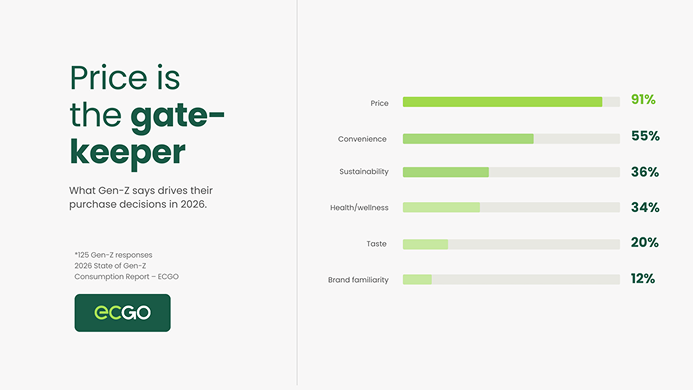
What this means in practice is that Gen-Z isn't building their daily routines around aspirational brands. They're building them around reliable ones. A brand doesn't need to be exciting every day. It needs to be there, priced right, and consistent in quality. That's the bar — and for the brands that clear it, the reward is embedded into the fabric of a person's day.
What This Means for Brands
The Daily Necessity Economy is not glamorous territory. It doesn't make for splashy campaign launches or viral moments. But it is where loyalty compounds quietly and powerfully over time.
Beverage brands, in particular, should understand that their competition isn't just other brands — it's inertia. Once a user establishes a habit, displacement requires more than a better product. It requires a better fit for the routine itself.
For all CPG brands operating in daily-use categories, the strategic implication is the same: stop trying to interrupt Gen-Z's day and start trying to belong to it.
To explore the full data behind these insights, download the ECGO 2026 State of Gen-Z Consumption Report at https://brands.ecgo.co/insights-trends/2025-state-of-gen-z-reports
.png)